
Blind, Female, and Left Behind
The Double Exclusion of Visually Impaired Girls in Pakistan’s Education System
A girl who cannot see has two strikes against her in Pakistan’s classrooms. The system only counts one.
PUBLISHED BY Dua Shuja Research and Program Consultant | visionwithoutbarriers.org DATE June 2026 FOCUS Pakistan | Disability | Gender | Education
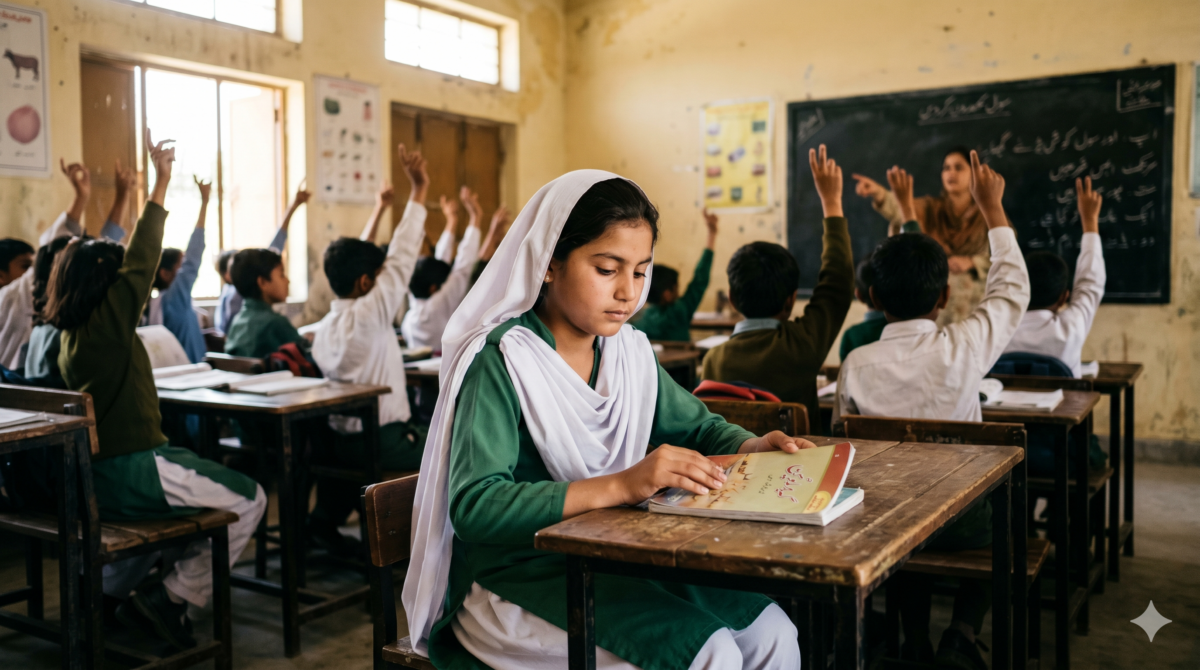
Amna was seven years old when her teachers stopped calling on her. Not because she was difficult, or slow, she was neither. She stopped being called on because she could not see what was written on the blackboard, and in the classroom of a government primary school in Multan, that was understood, without anyone saying it aloud, to be her problem. There was no assessment. No referral. No conversation with her parents about what she might need. There was only the quiet withdrawal of expectation, until the day her family decided that school was no longer worth the effort.
She is not an exception. She is the pattern.
THE NUMBERS BEHIND THE GAP
| 26M+ girls out of school globally due to disability (UNESCO) | ~52% of Pakistan’s blind population estimated female | <2% visually impaired women reaching higher education in LMICs | 71% disabled Pakistanis who are unemployed (World Bank) |
Two Barriers, One Body
Pakistan’s education crisis is well documented. The country has one of the largest out of school populations in the world, and girls bear a disproportionate share of that burden. Gender gaps in enrollment, retention, and literacy have attracted decades of policy attention, donor funding, and NGO effort. Progress has been real, if uneven.
What that conversation almost never accounts for is the girl who sits at the intersection of gender and disability excluded not by one system but by two at once. For a visually impaired girl in Pakistan, the barriers do not simply add up. They multiply.
A sighted girl in a rural district may face pressure to leave school early, economic strain on her family, and cultural expectations that weigh her domestic role against her education. A visually impaired girl faces all of that and on top of it: teachers who have no idea how to teach her, learning materials she cannot access, a family that may see her blindness as a reason to invest even less in her future, and a school that was never built with her in mind.
She is invisible to the gender equality agenda because that agenda tracks girls but rarely asks which girls. She is invisible to the disability agenda because that agenda rarely breaks its numbers down by sex. She falls between two conversations that were never designed to find her.
“I have never seen data on blind girls specifically. Every time I look, the numbers stop at ‘disabled’ or ‘female.’ Nobody is counting the overlap.”
— Disability advocate, Lahore VWB Consultation, 2025
What the Classroom Looks Like? When It Exists
Pakistan’s formal provision for visually impaired and blind students rests on a small number of special schools, most of them in large cities. These institutions do meaningful work under real constraints. They are also, almost by definition, out of reach for the majority of visually impaired children who do not live nearby, whose families cannot absorb the cost of relocation, or who as girls, face extra resistance from families uncomfortable sending daughters to residential facilities far from home.
The mainstream system, in theory, offers an alternative. Pakistan’s disability policy frameworks mandate the inclusion of disabled children in regular schools with appropriate support. In practice, this has produced, in most schools, almost nothing. No additional teacher training. No Braille textbooks. No assistive technology. The policy lives in documents. The classrooms remain unchanged.
A 2025 education survey in Punjab noted that children with disabilities were systematically undercounted in enrollment data in part because schools had no standard way to record disability, and in part because many such children had already left the system before the surveys reached them. You cannot track what you have decided, in advance, not to see.
The Teacher Who Was Never Taught
Helen Keller once wrote: “The most important day I remember in all my life is the one on which my teacher, Anne Sullivan, came to me.” She wrote those words as the first deaf-blind person to earn a university degree, a woman who reached that height precisely because one skilled, committed teacher had refused to give up on her. The education of a visually impaired child has always depended, more than almost any other factor, on the quality of the person standing in front of them.
Pakistan does not have enough of those people. It is not close to having enough.
The country’s teacher training programs produce graduates with nominal qualifications in special education, but those programs are limited in number, inconsistent in quality, and concentrated in cities. The vast majority of teachers who encounter visually impaired students in mainstream schools have received no training in visual impairment not in Braille, not in how to adapt a lesson, not in any of the adjustments that make the difference between a blind student learning and a blind student simply sitting.
For visually impaired and blind girls, this gap has a particular consequence. A girl who cannot access the curriculum depends entirely on a teacher’s willingness to adapt materials for her. When that willingness is absent as it almost universally is she falls behind. And falling behind, for a girl in Pakistan, quickly becomes a reason to leave: a family already uncertain about the value of educating their daughter now has what looks like evidence that school is not working. The teacher’s failure becomes the girl’s exit.
The Textbook Nobody Printed
Pakistan’s national curriculum is delivered through textbooks. Those textbooks are printed. They are not available in Braille. They are not available in audio. They are not available in any digital format that a screen reader can navigate.
This is not an oversight. It is a choice, made and remade across decades, not to spend the money that accessibility requires. The National Curriculum Council has issued guidelines. Provincial textbook boards have printed millions of copies. Accessible editions have remained, in the language of institutional delay, “under development.”
The effect on a visually impaired student is total. She cannot independently access her own coursework. She is dependent, at every step of her education, on a sighted person choosing to read to her or transcribe for her a dependency that trains her, from childhood, to understand her learning as a favor that others grant, not a right she can claim.
For girls, that dependency lands in complicated territory. The sighted person most likely to read to a visually impaired girl is a family member often a sibling, often male. This arrangement depends on the sustained goodwill of a household, breaks apart under any change in family circumstances, and carries its own quiet dynamics of obligation and inconvenience. It is not a solution. It is an improvisation that the system has allowed to substitute for one.
“My brother used to read my books to me. When he got busy with his own exams, I stopped studying. There was nobody else.”
Visually impaired student, Faisalabad — VWB Focus Group, 2025
The Cliff at Matriculation
For visually impaired girls who do survive the primary years through a combination of family support, personal determination, and the luck of encountering a teacher who cared about the secondary and matriculation stage presents a new and often final obstacle.
Pakistan’s Board examinations are not accessible. The standard provision for visually impaired candidates, a scribe, additional time, a separate room exists on paper and varies wildly in practice. The scribe system is particularly unreliable: a candidate must either provide her own or rely on one arranged by the examination board, a process riven with inconsistency. The quality of a scribe, their speed, their subject knowledge, their willingness to write exactly what is dictated without “helping” can determine results entirely. Two visually impaired girls sitting the same paper in different centers are, in effect, taking different examinations.
Beyond the examination hall, the path to university carries its own walls. Application processes are largely inaccessible online. Campuses are not designed for blind navigation. Only around 12 percent of Pakistani universities have assistive technology labs equipped with screen readers and Braille displays, according to data compiled by Vision Without Barriers. For the rare visually impaired girl who reaches the university threshold, the institution often treats her presence as a special case to be managed rather than a right to be upheld.
What Data Silence Tells Us
The most honest measure of Pakistan’s failure to educate visually impaired girls is not the enrollment figure. It is the fact that no reliable enrollment figure exists. Comprehensive, disaggregated data on visually impaired girls, tracking entry into school, progression through grades, dropout rates, exam results, and outcomes after school, does not exist at a national level.
Pakistan’s most comprehensive learning surveys do not systematically record disability type. The national Education Management Information System records disability in categories too broad to isolate visual impairment, and even those broad figures are believed to undercount significantly, because of stigma, inconsistent teacher reporting, and the simple fact that many disabled children have already left school before any survey reaches them.
This is not a data problem. It is a political problem wearing the clothes of a data problem. Governments do not lose track of populations they have decided to count. Pakistan’s visually impaired girls are uncounted because counting them would require acknowledging them, and acknowledging them creates the obligation to serve them. The silence in the data is itself a policy decision.
The Path Is Narrow, But It Exists
Helen Keller, who knew what it was to be written off before the world understood what she could do, said it plainly: “Alone we can do so little; together we can do so much.” VWB’s work in Pakistan is built on exactly that conviction, and it has surfaced something the statistics tend to hide: when a visually impaired girl receives structured support, accessible technology, and a clear pathway forward, she does not merely catch up. She accelerates. The loss has never been hers. It has always been the system’s.
The model that works is not complicated. It begins with early identification, before school failure becomes school exit. It requires accessible learning materials, Braille editions, audio formats, screen-reader-compatible texts, as a standard provision, not a special favor. It demands teachers who have been genuinely trained, not just certified. It needs examination processes that do not vary by location or the lottery of scribe quality. And it requires universities to treat accessibility as an obligation, not an accommodation they extend to individuals on a case by case basis.
VWB’s assistive technology labs at Government College University Lahore and Lahore College for Women University show what this looks like in practice. LCWU is particularly significant: a women’s university with accessible technology infrastructure is one of the very few places in Pakistan where the double exclusion of gender and disability is being actively dismantled. A visually impaired young woman who arrives there finds, however imperfectly, that the institution was expecting her.
That expectation, the simple institutional presumption that she will come, and that she deserves to be there, is what has been missing at every other level of the system. It is not primarily a question of resources. It is a question of who is considered worth imagining in the room.
What Must Change
The reforms are not unknown. They have been recommended, written into policy frameworks, and advocated for by disabled Pakistanis for years. What has been missing is not the roadmap. It is the resolve to follow it.
Disaggregated data must be collected. All federal and provincial education surveys must capture disability type and sex as linked variables. The gap in the data is not a technical limitation. It is a choice that can be reversed in the next survey cycle.
Accessible curriculum materials must be produced. Braille and audio editions of all standard textbooks must be commissioned, with a binding deadline for availability. “Under development” is not a policy position. It is a postponement.
Teacher training must be reformed. Visual impairment literacy must become part of all primary teacher training, not a specialty credential held by a handful of special education graduates. The mainstream classroom is where most visually impaired children will encounter the system first.
Examinations must be standardized. All Boards of Secondary Education must establish consistent, monitored protocols for visually impaired candidates, with quality-controlled scribes, audio question paper options, and independent oversight across centers.
Universities must budget for accessibility. Institutions must earmark a defined percentage of their budgets for accessibility infrastructure and staff training. Accessibility cannot remain dependent on individual goodwill or the next donor project cycle.
The Girl the System Was Not Built For
Amna, the seven-year-old in Multan whose teachers stopped calling on her, is now in her twenties. What happened to her after her family decided that school was no longer worth the effort is not known because nobody tracked her, because no survey was designed to find her, because the system that should have caught her had already decided, without ever saying so aloud, that she was not its responsibility.
That decision is made, every year, for thousands of visually impaired girls across Pakistan. It is made in the moment a teacher chooses not to adapt a lesson. It is made in the budget meeting that does not allocate funds for accessible materials. It is made in the survey design that does not ask the right question. It is made in the university prospectus that does not mention her.
Helen Keller, who knew, from her own life, what it meant to be written off before the world understood what she was capable of, put it in words that still hold: “The only thing worse than being blind is having sight but no vision.”
Pakistan’s education system can see this problem. It has been shown the evidence, heard the testimony, and read the recommendations. What it has not yet found is the vision to act on them. That is not a failure of capacity. It is a failure of will, and failures of will, unlike failures of resource, can be corrected the moment institutions decide they should be.
About Vision Without Barriers
Vision Without Barriers (visionwithoutbarriers.org) is a U.S.-registered 501(c)(3) nonprofit providing adaptive technology, screen reader training, and vocational support to visually impaired individuals in Pakistan and the Global South.
Sources & Further Reading
— UNESCO Institute for Statistics, “Girls’ Education and Disability: Global Overview” (2023)
— WHO-UNICEF Global Report on Assistive Technology (2022)
— Pakistan Journal of Neurological Sciences, disability employment data (2022)
— Vision Without Barriers, Lahore Focus Group Report (2025)
— National Policy for Persons with Disabilities, Government of Pakistan (2020)
— Sabar, Kanwal & Bashir, “Employment Challenges for Persons with Visual Impairment in Pakistan,” JBSEE (2024)
— Annual Status of Education Report (ASER), Pakistan (2023)
— FairPlanet: “Pakistan: Persons with Disabilities Demand True Inclusion” (December 2023)
— Global Burden of Disease Study 2017: Vision Loss in Pakistan (PMC)