
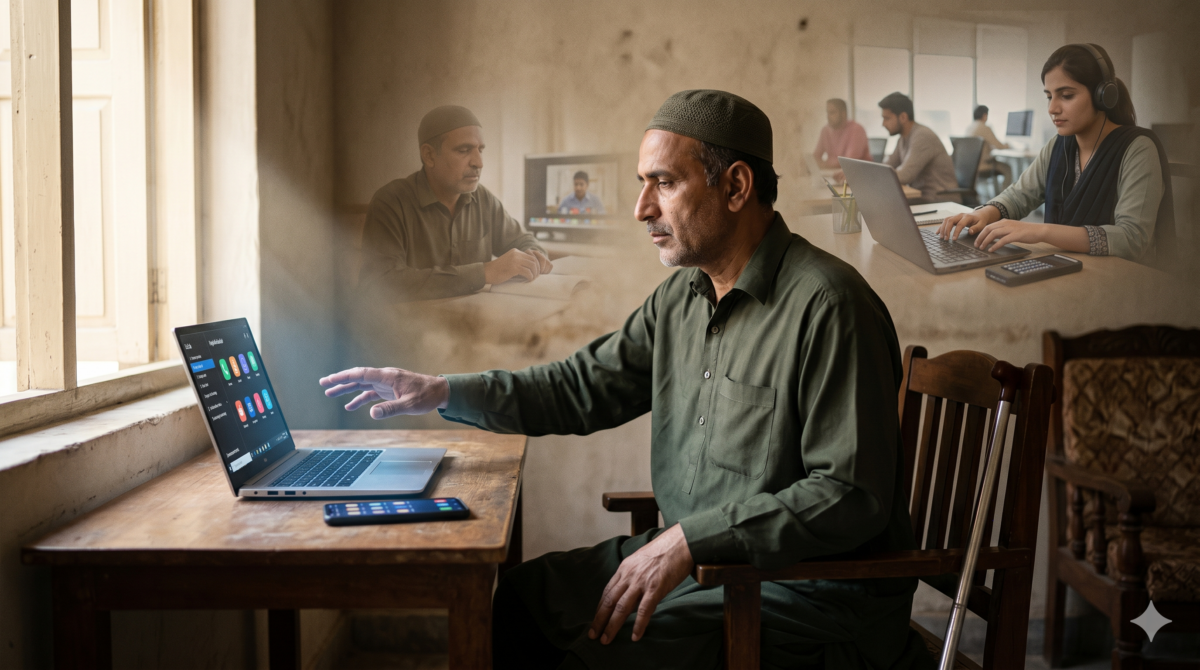
THE LAST METER
Why Pakistan’s Blind Citizens Get Smartphones But Never Learn to Use Them
PUBLISHED BY Laiba Usman | Vision Without Barriers | visionwithoutbarriers.org
DATE June 2026
FOCUS Pakistan | Disability Rights | Assistive Technology | Development Aid
VISION WITHOUT BARRIERS | RESEARCH & ADVOCACY
The Last Meter
Why Pakistan’s Blind Citizens Get Smartphones But Never Learn to Use Them
The technology exists. The devices are being donated. And still, millions of blind Pakistanis remain locked out of the digital economy — because the aid sector keeps confusing hardware with help.
Rizwan has worked as a telephone operator at a local bank in Lahore for years. He is punctual, conscientious, and completely blind. For a long time, he navigated his work and his world on a Symbian phone loaded with a screen-reading application called Talks, a workaround that worked, until it didn’t. When Symbian handsets disappeared from the Pakistani market, Rizwan was left without a device that could speak to him. He needed a smartphone. He needed training. He needed someone who understood that these two things are not the same.
He eventually found Vision Without Barriers, filled out a single form, and within weeks had a laptop loaded with adaptive software. “Almost 20 years dealing with different NGOs,” he wrote afterward, “this experience is one of its kind.”
What he didn’t say, but what his story implies is that for two decades, the system had mostly failed him. Not for lack of donated devices, but for lack of the one thing no shipping container can deliver: the knowledge of how to actually use them.
THE NUMBERS BEHIND THE GAP
3% — assistive tech access rate in some low-income countries (WHO-UNICEF)
71% — disabled Pakistanis who are unemployed (World Bank estimate)
33% — device abandonment rate globally among assistive tech recipients
12% — Pakistani universities with dedicated assistive tech labs
A Billion-Dollar Market with a Last-Mile Problem
The global assistive technology market for visually impaired users was valued at approximately $5.72 billion in 2024 and is projected to reach $21 billion by 2034. Governments in over 41 countries now offer subsidies for accessibility devices. NGO deployments of assistive technology have risen 37% in recent years. By every headline metric, the world is doing more for its blind population than ever before.
And yet: in low- and middle-income countries, where the need is most acute, access to assistive technology can be as low as 3% of what is actually required, according to the WHO-UNICEF Global Report on Assistive Technology. In Pakistan, where an estimated 1.12 million people are fully blind and millions more live with severe or moderate vision loss, the chasm between what exists and what reaches people remains staggering. Seventy-one percent of disabled Pakistanis are unemployed, according to World Bank estimates, a figure that, for those who are blind, is almost certainly higher.
The dominant explanation for this gap, in donor reports and NGO strategy documents, tends to focus on device access: not enough smartphones, not enough screen readers, not enough Braille displays. This explanation has the convenient virtue of being partially true, and the catastrophic flaw of being mostly incomplete.
The real bottleneck isn’t the last mile. It’s the last meter, the short, critical distance between a device sitting on a table and a blind person’s hands knowing what to do with it.
The Closet Problem
Walk into any household in Pakistan that has received an assistive device through a charitable program, and there is a reasonable chance you will find it in a drawer, or a closet, or propped against a wall gathering dust. This is not ingratitude. It is not incompetence. It is the entirely predictable outcome of giving someone a sophisticated piece of technology and no pathway to fluency.
A 2024-2025 market analysis of the assistive technology sector identified device abandonment as affecting roughly one-third of recipients globally, and that figure is drawn largely from higher-income populations with functional training infrastructure around them. In Pakistan and similar settings, where post-distribution support is often nonexistent, the abandonment rate is almost certainly far worse.
The reasons are structural. A 2025 peer-reviewed study published in Frontiers in Digital Health, examining assistive technology abandonment in the context of the AI era, identified three root causes: misaligned design (tools built for English-speaking, high-bandwidth users), inconsistent industry support (no follow-through after sale or donation), and, most critically inadequate user training.
In Pakistan, those three root causes are not individual failure points. They are a unified system of exclusion. Screen readers like JAWS and NVDA, the gold-standard tools for navigating a computer without sight, were designed in English, for English interfaces, tested on broadband connections, and priced for Western incomes. JAWS costs several hundred dollars for a full license. In a country where the median monthly wage sits well below $300, this is not an inconvenience. It is a wall.
What Training Actually Looks Like — When It Exists
In November 2024, the Virtual University of Pakistan ran a two-week train-the-trainer program that prepared 10 visually impaired trainers and 10 sighted assistants to teach basic computer skills to people with visual impairments. The program was run in collaboration with the ITU’s Digital Transformation Centre network. By the end of the second week, a trainee who had never touched a keyboard before could type and navigate independently.
Two weeks. That is the timeline between “device in hand” and “basic digital competence” when the training actually happens. The fact that this program is remarkable enough to be reported as a success story is itself a measure of how rare it is. Just over 12% of Pakistani universities have dedicated assistive technology labs equipped with screen readers and Braille displays. For the millions of blind Pakistanis who never attend university, the number approaches zero.
A focus group convened by Vision Without Barriers in Lahore in 2025, gathering visually impaired students, educators, and advocates, captured the frustration precisely. “The technology exists,” participants said, “but training does not. The gap is not always technological, it’s educational.” Tools like JAWS, NVDA, and OCR software were available in theory; in practice, they sat unused because nobody had taught anyone how to open them.
“The technology exists, but training does not. The gap is not always technological — it’s educational.” — VWB Lahore Focus Group, 2025
The Aid Sector’s Category Error
There is a concept in public health called the “know-do gap” the distance between what people know they should do and what they actually do. In assistive technology aid, there is an analogous failure: the give-use gap. The sector has become extraordinarily sophisticated at the first half of the equation. Devices are procured, shipped, customs-cleared, distributed, photographed for impact reports, and counted. The second half, the open-ended, labor-intensive, relationship-dependent work of turning a device into a capability, has no easy metric, no clean photograph, and no satisfying conclusion date.
So it gets skipped.
This is not a conspiracy. It is the logic of incentives. Institutional donors measure outputs. Outputs are countable. “200 smartphones distributed” is a sentence that fits in an annual report. “200 people trained to fluency across three months of follow-up sessions with ongoing technical support in their mother tongue” is a program that costs three times as much, takes five times as long, and produces outcomes that are harder to photograph.
The consequences are real and measurable. A person given a smartphone they cannot use has not been helped. They have been given a paperweight with a charging cable. Worse: they may internalize the failure as their own — a confirmation of the low expectations society already has for them, when the failure is entirely institutional.
What the Full Model Looks Like
VWB’s approach in Pakistan starts from a different premise: that the device is not the intervention. It is the precondition for the intervention. A laptop or smartphone loaded with adaptive software is the equivalent of a door. Training is the key. Vocational support, connecting a newly skilled blind person to actual economic opportunity, is the reason you opened the door in the first place.
The sequence matters. Device without training produces the closet problem. Training without vocational follow-through produces a skilled person with nowhere to go. All three elements, delivered in sequence, produce something the aid sector rarely generates in this population: economic independence.
VWB has established high-tech assistive labs at institutions including Government College University Lahore and Lahore College for Women University. GCU’s Centre for Special Students, supported by VWB technology, now hosts over 300 students, backed by specialized staff. The organization trains blind individuals in digital skills, coding, digital marketing, content work, that are portable, remote-accessible, and denominated in international currency.
The vocational logic is precise: a blind Pakistani trained to navigate a screen reader and deliver professional digital services is competing on a global freelancing platform where no employer can see them, and where the only differentiator is skill. The barrier that operates everywhere in the physical economy, the employer’s visual assessment, the inaccessible interview room, the colleagues who don’t know what to do, evaporates. What remains is competence.
The Policy Vacuum
Pakistan’s Disabled Persons (Employment and Rehabilitation) Ordinance mandates a 2% employment quota for persons with disabilities in public and private sector organizations. In 2020, updated legislation reaffirmed these protections. In practice, implementation remains extremely low, according to a 2022 Pakistan Journal of Neurological Sciences report. Pakistani President Dr. Arif Alvi publicly acknowledged the failure of quota enforcement, calling for action. As of mid-2026, blind Pakistanis still routinely face job rejection, inaccessible government portals, and public institutions without a single functional assistive device.
A 2025 VWB focus group made two specific policy demands: that the Higher Education Commission update its disability framework and require full university adoption by the end of 2025, and that universities earmark at least 1% of institutional budgets for accessibility upgrades and staff training. Neither has been systematically implemented.
Meanwhile, the international community has not filled the gap. The WHO and UNICEF’s 2022 Global Report on Assistive Technology, the most comprehensive global audit ever conducted, noted large gaps in trained workforce for assistive technology across 70 surveyed countries, particularly in low-income settings. Drop-in pilots and consultative surveys cannot substitute for a funded national infrastructure of assistive technology training.
The Arithmetic of Inclusion
Consider what the last meter actually costs, relative to what it produces.
The marginal cost of training a blind individual to professional digital competence, beyond the device they already have, is a few hundred dollars in instructor time, software licensing support, and follow-up sessions. A screen reader license, when provided through an organizational arrangement rather than individual retail purchase, costs far less than its retail price. Three months of structured training, delivered by a blind trainer, transforms a device from a liability into a livelihood.
A blind Pakistani professional billing international clients on a freelancing platform at even modest rates generates income that dwarfs the cost of their training within months, and continues generating that income for years. The return on investment is not complicated. It is merely invisible to a sector organized around device counts rather than life outcomes.
What VWB’s model makes legible is something the aid sector has systematically obscured: the person on the other end of a donation is not a recipient. They are, given the right inputs, a professional. An earner. A taxpayer. A role model for the next blind student who needs to see that the path exists before they can believe it.
The Last Meter Is Not a Metaphor
In logistics, the last mile is the hardest, most expensive, most human-intensive part of any delivery chain. The same physics apply to human capability. Getting a device to someone is a supply chain problem. Turning that device into a career is a human development problem. They require different skills, different timelines, different relationships, and different measures of success.
The global assistive technology sector has, broadly, solved the supply chain problem for the communities it reaches. It has not solved, and has often not seriously attempted to solve, the human development problem. Until it does, the closets of Pakistan will keep filling with expensive, well-intentioned objects that nobody taught anyone to use.
Rizwan eventually got his laptop. He got his training. He returned to work, not as a charity case navigating a hostile system, but as a skilled professional with tools matched to his abilities. His story is not a feel-good ending. It is a proof of concept. And a rebuke.
The question is not whether we can close the last meter. We know we can. We have the trainers, the tools, the models, and the evidence. The question is whether the institutions that hold the money will stop counting devices and start counting lives.
About Vision Without Barriers
Vision Without Barriers (visionwithoutbarriers.org) is a U.S.-registered 501(c)(3) nonprofit providing adaptive technology, screen reader training, and vocational support to visually impaired individuals in Pakistan and the Global South.
Sources & Further Reading
— WHO-UNICEF Global Report on Assistive Technology (2022)
— Ventura, Hamilton-Fletcher & Rizzo, “From Abandonment to Adoption,” Frontiers in Digital Health (January 2026)
— ITU Digital Impact Unlocked: “Inclusive Digital Education for Visually Impaired People in Pakistan” (2024-2025)
— Express Tribune / VWB: “Breaking Barriers for Blind Students in Our Varsities” (July 2025)
— Pakistan Journal of Neurological Sciences, disability employment data (2022)
— FairPlanet: “Pakistan: Persons with Disabilities Demand True Inclusion” (December 2023)
— Global Burden of Disease Study 2017: Vision Loss in Pakistan (PMC)
— Advance Social Science Archive Journal, Vol. 03-04, 2025
— Sabar, Kanwal & Bashir, “Employment Challenges and Opportunities for Persons with Visual Impairment in Pakistan,” JBSEE (2024)
Disclaimer
This article is published by Vision Without Barriers for informational and educational purposes. All content, including text, graphics, and other materials contained herein, is protected by copyright and intellectual property laws. Vision Without Barriers retains all rights to publish, distribute, and display this content through its platforms and channels.
The views, opinions, and insights expressed in this article are those of the author. The author retains full control over the content and its intellectual contributions. Unauthorized reproduction, distribution, or use of this material without prior written permission is prohibited.